


Words long forgotten and never known — On rare terms of book printing and printmaking
DOI: http://doi.org/10.54544/662
|
In the July 2020 issue of Science and Life, a popular Russian-language science monthly published in Moscow, an article appeared which was titled "On one forgotten word.",1 The article was devoted entirely to the leather ink balls. It turned out that not only the tool itself was no longer in use, but also both the word and the concept have all but disappeared. This web publication provides a brief summary of the Science and Life article and supplements it with several sketches about similar printing tools that, due to space constraints, had to be omitted from the journal version. |
|
|
|
Briefly about ink balls One of Johannes Gutenberg's inventions, once a readily-recognizable symbol of the trade, leather ink balls have faithfully served typographers around the world as an indispensable tool of letterpress printing and printmaking for nearly four centuries. Their design, size, materials, manufacturing techniques, and storage methods varied considerably from one region to another, but the key features remained invariant — a pair of specially treated leather pads with a smooth and clean surface, neatly rounded, tightly stuffed with horsehair or wool and attached to wooden handles (Fig.1). |
|
|
|
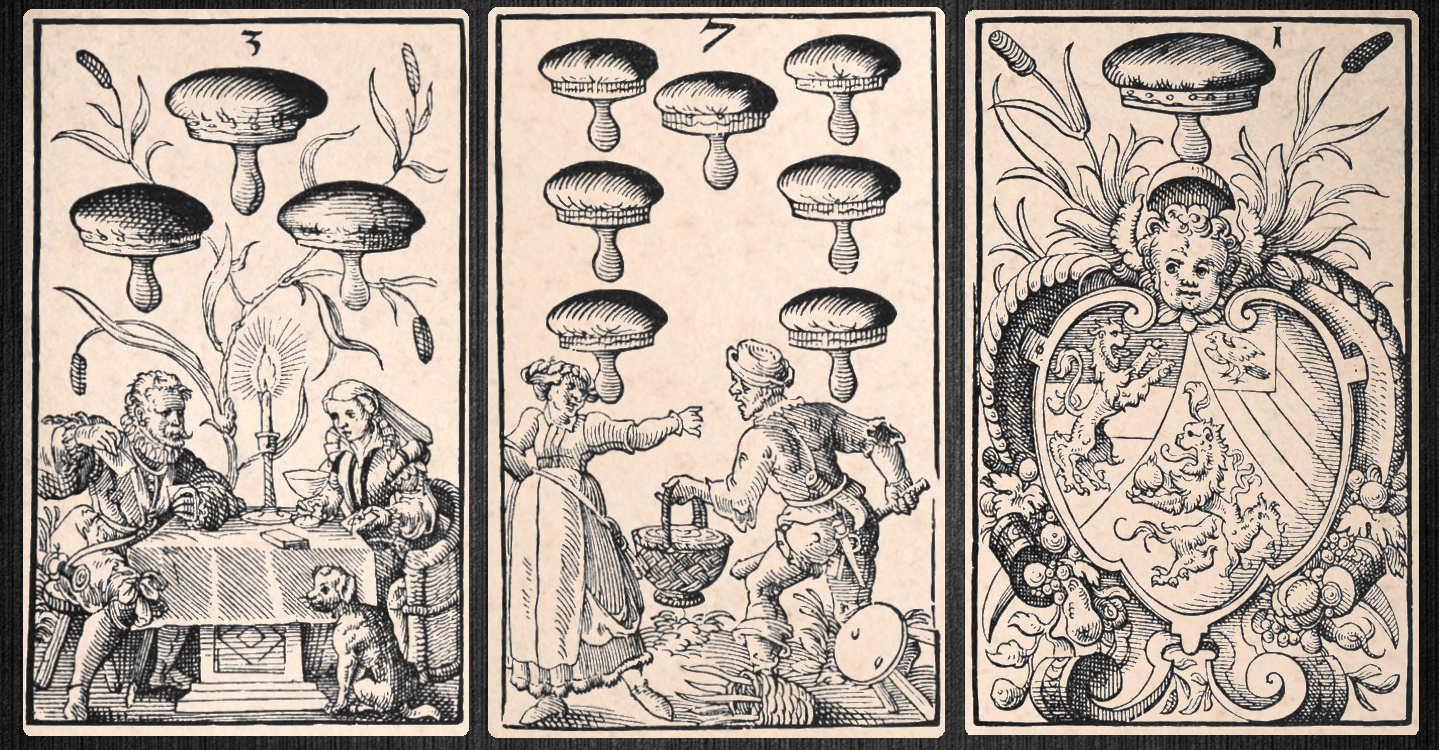
This tool turned out to be an ideal solution for a specific technical problem — to spread the printer's ink into a uniform thin layer and to apply it to the raised elements of a letterpress forme or a woodcut block. First, after dipping the ink balls in ink, the printer taps them against each other, distributing the ink evenly over the surface of both ink balls. Then, working with both hands, he dabs them over the printing forme, while continually rotating them, to ensure that the raised elements are completely and evenly covered with ink, leaving no bare spots, while avoiding filling the open spaces between the types and the recesses between the higher areas of the relief (Fig. 2). The ink balls entered the public consciousness, became an ubiquitous attribute of typographic signs, printer's devices, professional guild and personal heraldic emblems, and even playing cards (Fig.3). |
|
|
|
Then, the 19th century brought industrialization. In England, a new material, a predecessor of rubber, was invented. It became known as a composition (or масса in Russian) — a mixture of molasses, tar, and glue. When this mixture solidified, it formed a hard but elastic substance. At first, the composition just replaced the wool-stuffed leather pad, so that the ink balls retained their traditional shape. But very soon people figured out how to shape the composition into a solid seamless cylinder. Thus a composition roller was born. The era of the leather ink balls came to an end. |
|
|
|
The Extraordinary Adventures of the Ink Balls in the Russian Language The Russian word for ink balls, along with many other printing terms, has Italian origin. Among the two printers working at the printing press, the one who inks the moving type is called баты́рщик (from Ital. battitore), the other one who directly operates the press is known as тередо́рщик (from Ital. tiratore). The Italian word mazza, which means a bat, got adapted into a Russian ма́тца. It is in this form that the word appears in the historical texts up to the mid-19th century. While the tool itself remained in business and the word was in active use, it naturally required all the declension forms and derivatives: nom. sing. — ма́тца, nom. pl. — ма́тцы, gen. pl. — ма́тец, adj. — ма́течный. But once the tool became obsolete and the word only needed the nominative form of dictionary entries, the letter T got dropped. In Vladimir Dahl's famous Explanatory dictionary, the word appears in the form ма́ца. That is, except for the vocal stress, it became a homograph of matzah (Rus. маца́) — a dry, unleavened flatbread which belongs to the traditional Jewish cuisine and is an integral component of the Passover celebration. |
|
|
|
After the Bolshevik revolution of 1917, the Soviet authorities did their best to completely write off the ink balls in an attempt to "renounce the old world" (quoting the opening line of the Russian Communist adaptation of La Marseillaise, the French national anthem with the original lyrics by Claude Rouget de L'Isle). Thus, the word is absent from the key explanatory dictionaries of that period, as well as from the Great Soviet Encyclopedia. Forgetting something does not require much sophistication. Starting from about mid-60s, some scientific papers on history of technology contained a discovery: "To ink the movable type, a printer would use a маца, that is, a large leather glove."2 |
2 See, for example,
the website of The State Historical Museum of the Russian Federation: |
|
|
However, the confusion doesn't stop here. In numerous traditional and online Russian-language publications in circulation today, including popular history-of-technology books, reference sites, and educational question banks nominally belonging to different authors, the process of inking the type is described in a curious paragraph that is being reproduced nearly verbatim in multiple sources. Referring to the application of ink as "wiping over" the type, the paragraph asserts that the applicator, the matsa, had to be "soaked in water for 7-8 hours to soften it and make it pliable" and to be "replaced frequently" to retain smoothness.3 |
3
In the original Russian: "Набор смазывали тонким слоем краски: эту работу выполнял специальный работник.
Краску он наносил при помощи мацы, которую очищали и вымачивали в воде 7-8 часов, чтобы размягчить и сделать эластичной.
Мацы приходилось часто менять..." Several Internet examples reusing this text can be readily identified with any [AI-enhanced] search engine. |
|
|
If one assumes that the word matsa means an ink ball, trying to make technical sense out of this paragraph raises numerous questions and doubts. First, the printer worked with two ink balls—not just one—dabbing the ink onto the printing block rather than merely wiping over. Next, one must never "soak" the stuffed ink balls in water: saturating the filling (wool or horsehair) with liquid would render them unusable. Finally, there was absolutely no need for "frequent replacement." The ink balls were finely crafted trade tools designed for prolonged use. In the course of the day work, it sufficed to periodically clean clumps of ink off the leather surface. It is during the breaks, specifically overnight, when the ink balls indeed required maintenance. To prevent the leather from drying out and losing its elasticity, they were wrapped in a cloth soaked in ammonium hydroxide or, simply put, stale urine. Depending on circumstances, perhaps, every few days or weeks, the ink balls were restuffed with fresh filling. On the other hand, the phrase "soaking matsa in water" sounds eerily reminiscent of a traditional step in many Jewish culinary recipes. Could this be a case of a comical mix-up between two homographs sharing transliteration matsa: the printing tool (Rus. ма́ца) and the Jewish ritual unleavened bread (Rus. маца́)? Although Russian authors reusing the cited fragment typically did not attribute the source, it is not difficult to trace its proper origin. The fragment comes from the 1998 Russian translation of a monograph by the internationally acclaimed Lithuanian bibliographer Levas Vladimirovas (1912–1999).4 An attempt to unravel the confusion by researching the source confirms the mix-up hypothesis mentioned earlier. The translation explains that applying the ink to the printing forme or burnishing the paper against it can be done with a tampon, a brush, or matsa. As the Russian grammar requires these nouns to be placed in the Instrumental case, the translation uses the form мацой (with the vocally stressed ending),which unambiguously indicates that the the translator and editors indeed kept flatbread in their imagination. The Instrumental case of the noun ма́ца (an ink ball, with the vocal stress on the first syllable) is ма́цей. But how is it possible that a world-renowned book scholar and director of the Dag Hammarskjöld UN Library in New York had written such a clumsy text!? |
4 Л.И.Владимиров. Всеобщая история книги — Москва: Книга, 1988. С.99–100. 5 Ibid. P.96. 6 Levas Vladimirovas. Knygos istorija: senovė, viduramžiai, renesansas, XVI–XVII amžius. — Vilnius: Mokslas, 1979. P.151,159. |
|
|
To realize that it is the Russian translator who is responsible for text corruption, one has to consult the Lithuanian original.6 Speaking of matsas (Lith. maca; plural macos), Levas Vladimirovas meant specifically the printing tool. He highlighted the Italian origin of the word and used it to denote both the ink balls and the paper burnishing device. It is not the macos themselves that are cleaned and soaked in water, but merely the leather intended for their production. The frequency of replacing the macos is linked to the gradual wear of the leather surface. Yet, the reader of the Russian translation was presented with a completely different picture: a worker wipes out the type with water-soaked flatbreads, replacing them after every printed sheet. As for the "experts" on the history of book-printing who published an excerpt from Levas Vladimirovas’s monograph under their own names—sometimes, a mindlessly reproduced absurdity exposes a plagiarist more effectively than any plagiarism-detection system. |
|
|
|
Better to see it once... Nevertheless, through the efforts of living history museums and early printing enthusiasts around the world, the ink balls — this culturally important object — survive even today. One can see them in operation or even try oneself in the art of printing working as a beater (aka батырщик or battitore). On the illustration to the right, Gary Gregory, the founder, president, and director of The Printing Office of Edes & Gill in Boston, MA, which reconstructs demonstrates the operation of a press during the period of American Revolution.7 Another example: the printing demo at the Crandall Printing Museum in Alpine, UT, founded by Louis E. Crandall in 1988.8 |
7 https://www.youtube.com/watch?v=utLL2hfsZQU 8 https://www.youtube.com/watch?v=DLctAw4JZXE |
|
|
Ink balls in European languages The Italian word mazza (a bat) is functional. In many other languages, as in English, the corresponding term points to the round shape of the implement: German — Druckerballen, English — ink ball, Dutch — inktbal or drukkersbal, Finnish — väripallo, French — just balle.
|
9
Бібліологічні вісті, 1–4, Львів, 1999. С.59 |
|
|
Let us now turn to other applications of the relief-printing method and the tools used in such applications. |
||
|
Printing on fabric(the case of the former Russian Empire) Printing on fabric is ubiquitous in many cultures around the world and can trace its roots to far more ancient times than book printing. A printing block with raised pattern is covered with ink or dye (to apply to the fabric in the direct printing method), etchant (to remove color from the already uniformly dyed fabric), or resist (such as wax, to prevent color transfer to the specific areas in the course of subsequent dyeing). Then the pattern is transferred from the printing block to the fabric, and fabric is subjected to any post-processing, if necessary. The most ancient examples of printed fabrics manufactured within the confines of the former Russian Empire were discovered in Ukraine. Those date back to approximately the 11th century (Fig. 6). They had been discovered in 1874 by a prominent archeologist of Ancient Rus D.Ya. Samokavsov (1843–1911), who excavated burial mounds near the village of Levinki in the Chernihiv region.10 |
10
https://books.google.com/books? |
|
|
Two main methods of applying designs to fabric are described in the literature. In the most common case, the printer spreads the fabric on a flat surface, places a printing block on top of it, and taps the block from above with a hand or a wooden mallet. This is the method used, for example, to produce Pavlovo Posad shawls. The coloring agent is applied to a printing block with the help of a chassis, that is, a wooden box or a container. The chassis is partially filled with a thick substance (загустка) to create an elastic base, which is then covered with a layer of a waterproof material and a cloth saturated with the dye. When a printing block (called цве́тка or ма́нера) is lowered into a chassis and pressed against the cloth, the dye is transferred to the raised elements of the block.11 |
11 https://www.youtube.com/watch?v=cMZCp6iU3og |
|
|
The second of the methods described in the literature is used particularly in Ukraine. A printing block (Ukr. лице́ [litse]) is mounted horizontally with the carved surface facing up. The fabric then is placed on top and either tapped or rolled in from above. The coloring agent is applied to the surface of the block with a pair of leather pads known in Ukrainian as товку́ши [tovkushi]. "Tovkusha, -shi, fem. — among fabric printers, a tool for applying the paint to the pattern block: a square board with a handle on top and a leather pad below." 12 There is a direct analogy between tovkushi and typographic ink balls. "The paint is applied to the two stuffed leather pads (or tovkushi). These pads are attached to the rectangular boards with handles. First, they are beaten against each other to spread the paint uniformly, and then beaten against the carved pattern board to cover it with paint."13 An example of a textile printing block with miniature pattern elements is shown in Fig.7 and Fig.8. Its design suggests that, most likely, the paint was supposed to be applied to it with an ink pad (tovkusha) rather than by pressing against a paint-saturated cloth. The block was carved from wood and embellished with inlaid copper strips and wires, which could ensure fine and sharp pattern lines. |
12 Словарь української мови: в 4-х тт. / За ред. Б. Грінченка. Київ, 1907–1909. Т. 4. С. 270. 13 Н. Дубина «Откуда есть пошла»... печать по ткани. |
|
|
Xylography and movable type (China) Printing, that is, the reproduction of texts and images by transferring their reversed representation onto a forme and producing impressions from that forme on paper, is counted among the Four Great Chinese Inventions, alongside paper itself, gunpowder, and the compass. The earliest method of printing is xylography, in which the forme is a wooden block bearing the entire text or image carved in relief. The art of xylography was already known in China by the 6th century CE. Some sources place its origins even further back, in the 3rd century. The labor-intensive nature of the process was offset by the possibility of producing large numbers of impressions. Among the earliest subjects were Buddhist devotional images, ritual texts and talismans, while reproductions of landscape and genre paintings, as well as poetic and scholarly texts, appeared considerably later. The delicacy and absorbency of Chinese rice paper, another one of the Four Great inventions, combined with the technique of hand rubbing made it possible to print with relatively light pressure, in contrast to the technology that later became widespread in the West, which employed rag paper and bulky relief-printing presses. In their work, hand-printing craftsmen used a specialized set of brushes made predominantly from palm fiber — 棕刷 (zōng shuā). The basic set included a vertical brush 立刷 (lì shuā) for applying ink to the printing block and a horizontal rubbing brush 横刷 (héng shuā) for transferring the image onto the paper. |
|
|
|
The invention of movable-type printing is attributed to the craftsman Bi Sheng (毕昇; c. 990–1051 CE) from YingShan county (present-day Hubei province) and is dated to the period between 1039 and 1048. Initially, the type pieces were made of clay (ceramic movable type) and each character was baked in fire to harden it. Subsequently, variations of the method using wooden and metal types were developed. Although the introduction of movable type represented an important advance in printing, the set of tools used in the process remained virtually unchanged.14 |
14
Demonstration of movable type printing with ceramic type |
|
|
Stone rubbing (China) The tradition to immortalize in stone the most important canonical texts, such as Analects by Confucius, works of classical poetry, Buddhist sutras, calligraphic masterpieces, etc., had existed in China since ancient times. Engraving such texts in recessed relief on stone steles developed into a distinctive plastic (i.e., three-dimensional) art form.15 With the invention of paper in the second century CE, it became possible to make copies of such reliefs for state and private libraries, giving rise to and fostering the development of a new kind of graphic art. This graphic art form is denoted by the Chinese character 拓 (tà or tuò) and is known in English as stone rubbing. It is believed to have a history spanning at least fifteen centuries and is considered to have been one of the technological precursors of book printing. |
15 Beilin Museum (Forest of Stone Steles), Xi'an, Shaanxi province.. |
|
|
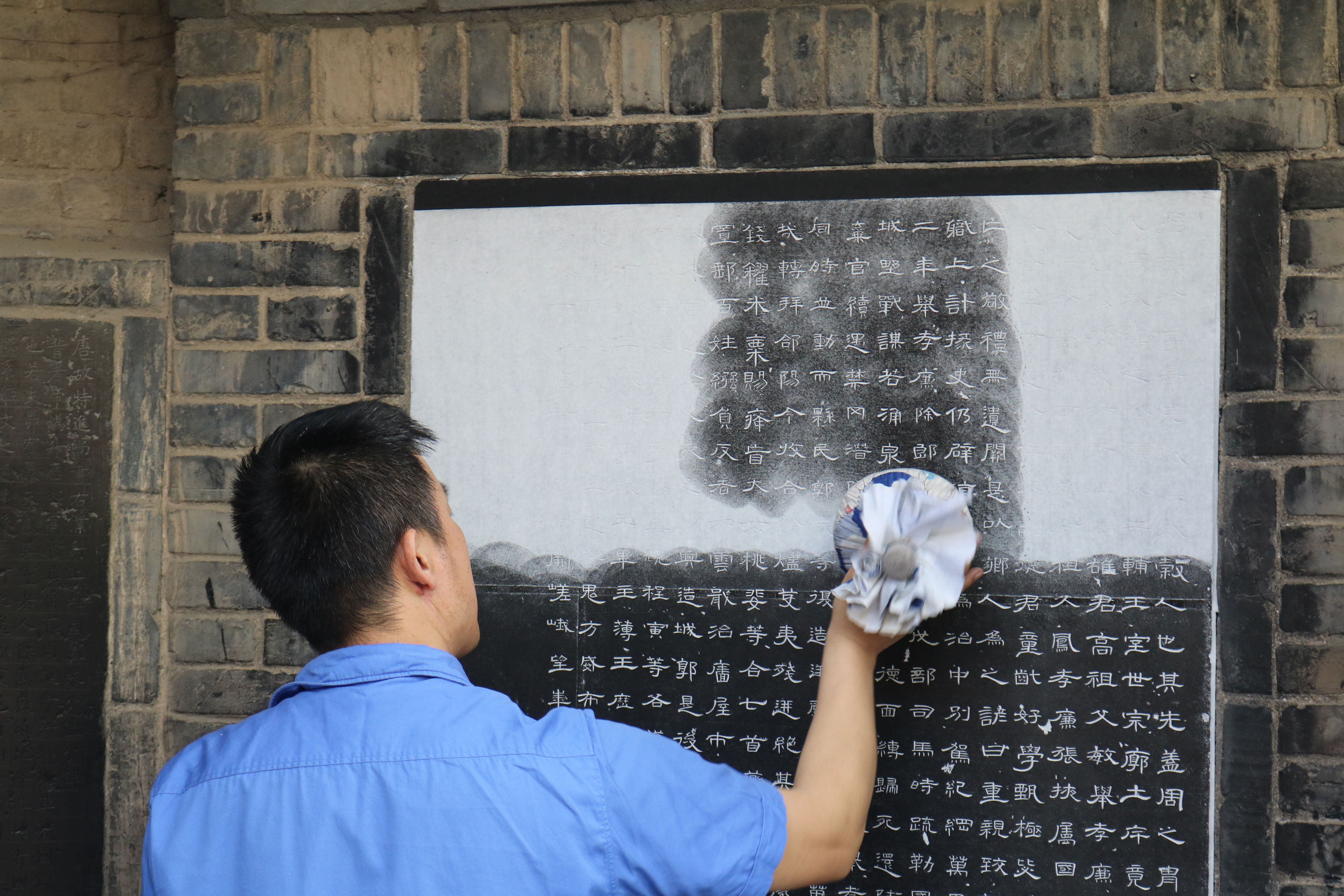
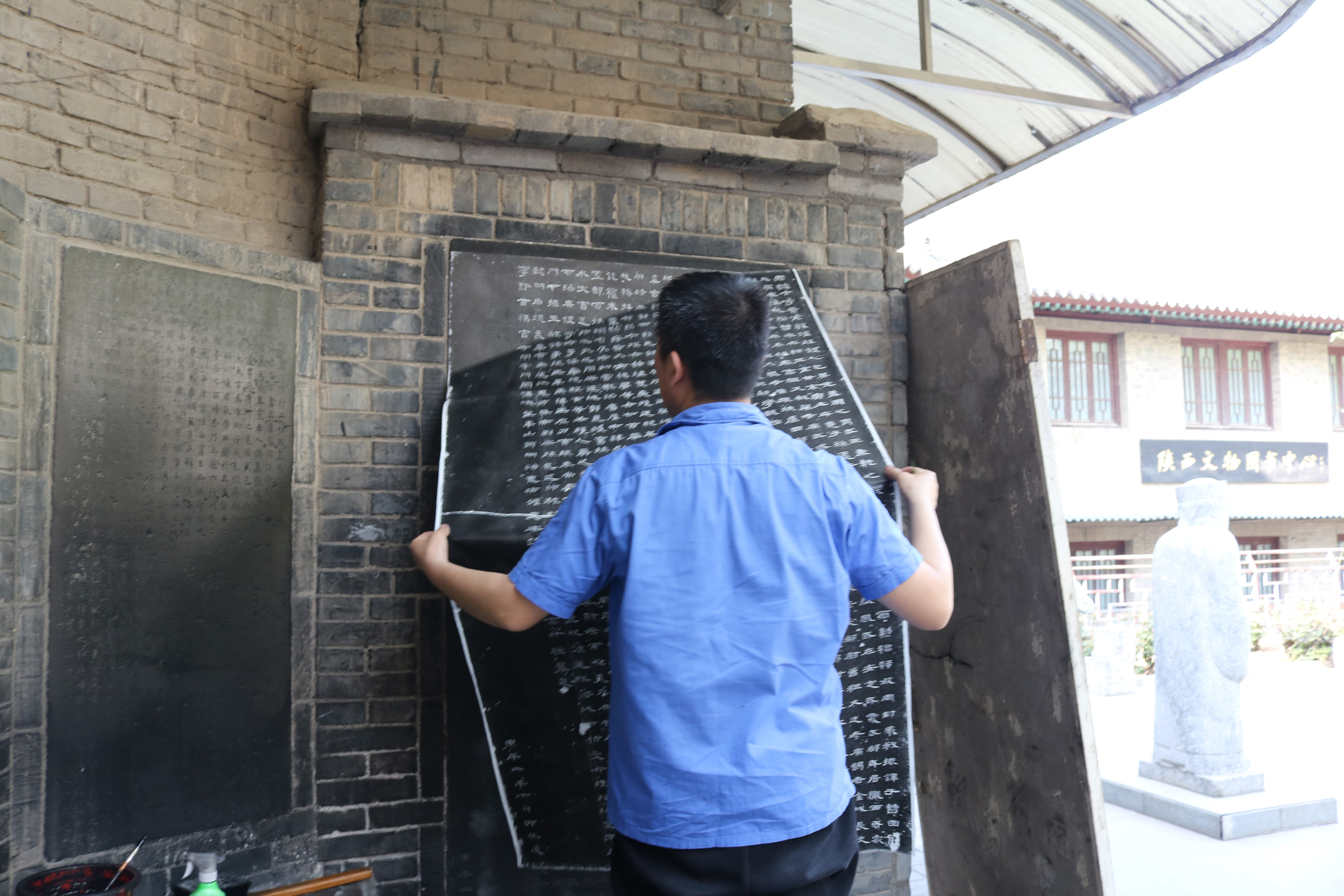
Making a rubbing imprint on paper involves the use of an instrument known as 拓包 (tà bāo) which looks very much like a typographic ink ball. The second character means a packet, a wrap, or a dumpling. The name of this tool is commonly translated into Russian as тампон табао, or, literally, a tabao pad. A moistened sheet of paper is laid over the inscribed stone surface; then a special brush is applied to tamp the paper into every depression on the surface. Thereafter the artist uses one or two tabao pads (on vertical or horizontal surfaces, respectively) to apply the coloring pigment to the exterior side of the paper sheet. In doing so, the depressed areas remain uncolored. As a result, an imprint of the inscribed surface is formed on the paper, which, unlike the letterpress or engraving print, is a direct copy of the original form, rather than its mirror image. |
|
|
|
For many centuries of its history, the art of stone rubbing has developed numerous styles and directions. The most obvious classification criterion is based on the type of coloring pigment: the 墨拓 (mò tà) type imprints employ back ink, whereas the 朱拓 (zhū tà) type imprints, the cinnabar or other bright red pigment. Also, already more than a thousand years ago, the distinction emerged between the imprints of "golden-black" style made in the saturated shiny black tone (烏金拓, wūjīn tà), and the imprints of the "cicada wing" style with light translucent shades, which form what can be called a graphic rhyme (蝉翼拓, chányì tà).
|
16 В.Г.Белозёрова. Традиция китайских тушевых оттисков. Восток (Oriens) 2015, №1, С.53–68. 17
https://www.youtube.com/watch? |
|
|
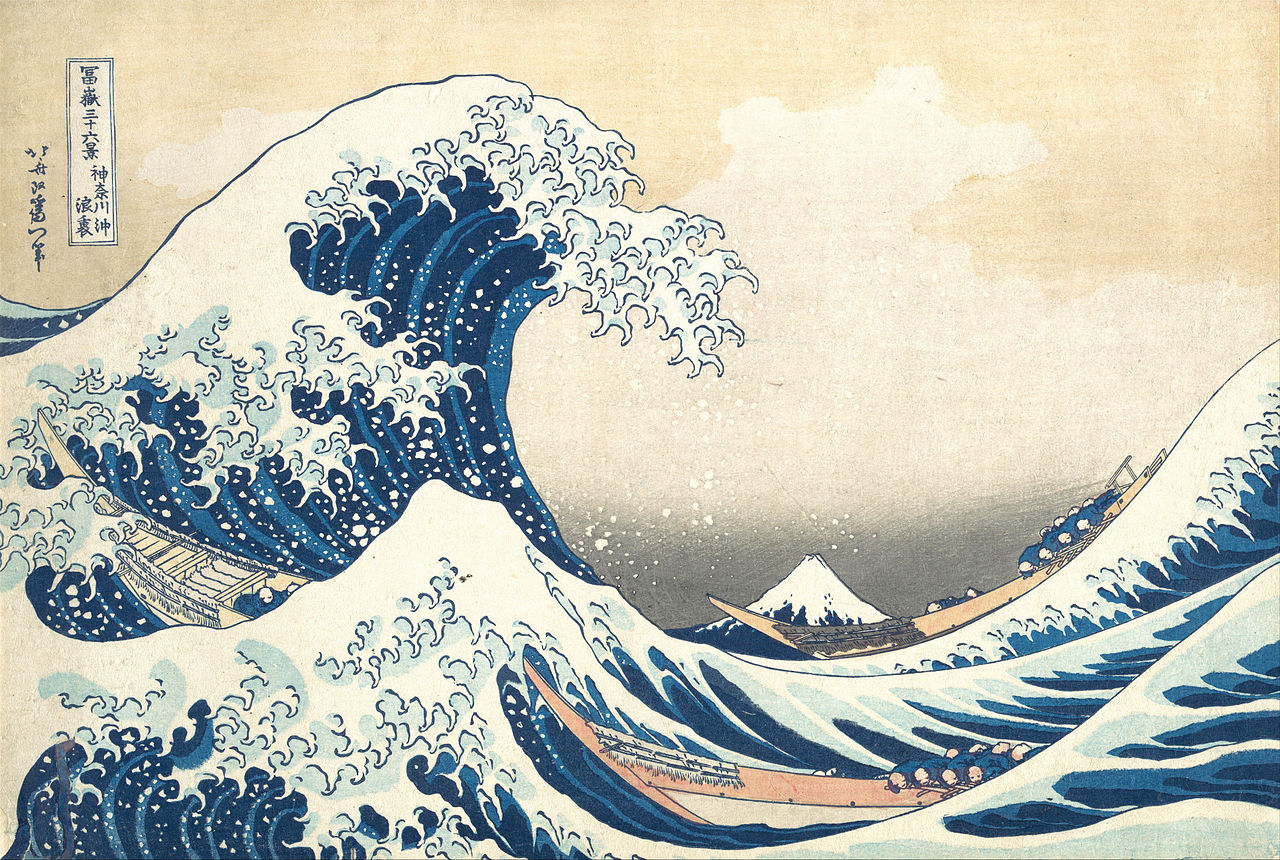
Polychrome xylography (Japan)
|
18
https://www.youtube.com/watch? |
|
|
|







| < Папярэдні | Наступны > |
|---|